

Projectile motion is one of the most important concepts in physics, especially in Class 11, NEET, and JEE preparation. It explains how an object moves in a curved path when it is thrown into the air and is influenced only by gravity and its initial velocity. From a cricket ball hit into the sky to a football kick or rocket launch, projectile motion is all around us in daily life.
What is Projectile Motion With example?
Projectile motion is the motion of an object that is thrown or launched into the air and moves along a curved path due to the force of gravity. It happens when an object has an initial forward velocity and is pulled downward by gravity, causing it to follow a predictable arc-shaped path. Examples include a ball being thrown, a rocket launched at an angle, or water sprayed from a hose.
Types of Projectile Motion
- Horizontal Projection
- Object is projected horizontally from a height.
- Example: A stone thrown horizontally from the top of a building.
- Oblique Projection
- Object is projected at an angle with the horizontal.
- Example: A football kicked at an angle, or a cricket shot.
Equations of Projectile Motion
Let an object be projected with velocity u at an angle θ with the horizontal:
- Horizontal velocity = ux=ucosθ
- Vertical velocity = uy=usinθ
1. Time of Flight (T)
T=2usinθ/g
(Time taken by the projectile to complete its path)
2. Maximum Height (H)
H=u2sin2θ/2g
(Highest point reached by the projectile)
3. Horizontal Range (R)
R=u2sin2θ/g
(Horizontal distance covered by the projectile)
Real-Life Examples of Projectile Motion
- Throwing a Ball – When you throw a ball at an angle, it follows a parabolic path before coming down.
- Cricket Shot – A batsman hitting the ball high in the air demonstrates projectile motion.
- Football Kick – A football kicked at an angle shows curved projectile motion.
- Water Fountain – Water ejected at an angle from a fountain nozzle follows projectile motion.
- Cannon or Rocket Launch – Objects fired at an angle move in a parabolic path under gravity.
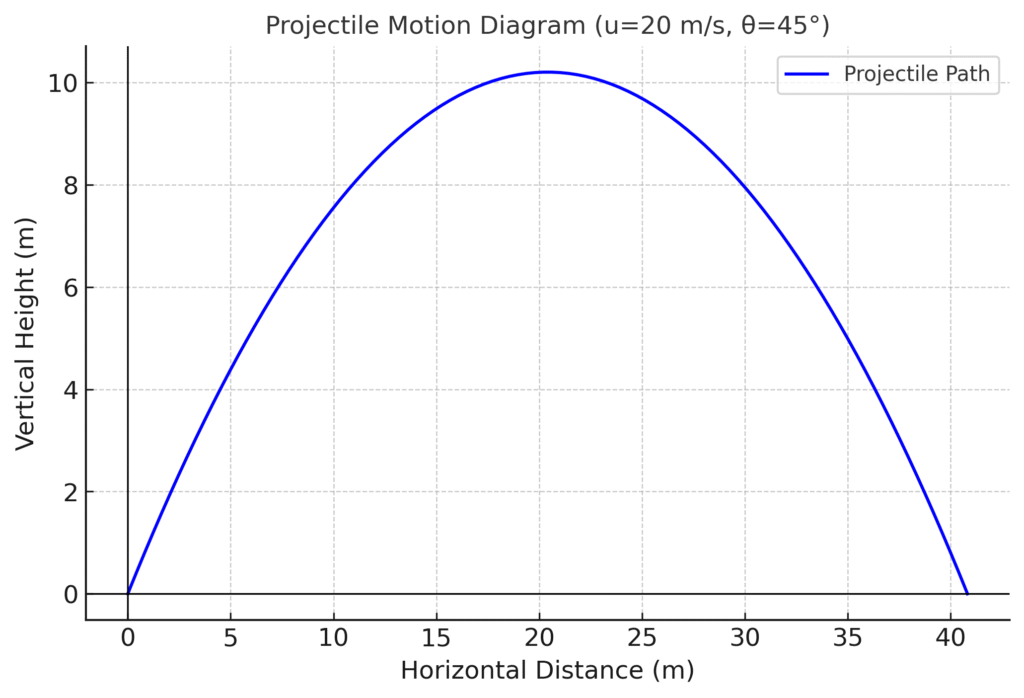
Here’s a projectile motion diagram showing the parabolic path of an object thrown at an angle (u = 20 m/s, θ = 45°).
| Term | Definition | Symbol and Formula |
|---|---|---|
| Launch Angle or Angle of projection | The angle at which the projectile is launched relative to the horizontal axis. | θ Not directly calculated |
| Initial Velocity | The speed at which the projectile is launched, determining the horizontal and vertical components of the motion. | v0 Not directly calculated, but its components are as follows:Horizontal: vx0 = v0 cos θVertical: vy0 = v0 sin θ |
| Time of Flight | The total time a projectile remains in the air from launch to landing. | T = 2 vo sin θ/ g |
| Horizontal Range | The horizontal distance traveled by a projectile before hitting the ground. | R = v02 sin 2θ/g |
| Maximum Height | The highest vertical point is reached by the projectile during its motion. | H = v02 sin2 θ/ 2 g |
Conclusion
Projectile motion is a combination of horizontal and vertical motion under the influence of gravity. It explains why objects like balls, arrows, or even fountains follow curved paths instead of straight lines.
For students, remembering the equations of time of flight, maximum height, and range is crucial for solving Class 11 physics, NEET, and JEE problems.
So, next time you watch a cricket shot or a football kick, remember—you are witnessing projectile motion in real life!
What is Projectile Motion With example, this note gives you confidence every time you read.